30 years Hochschule Bonn-Rhein-Sieg
Exhibition Visionary Female Researchers: Grace Hopper
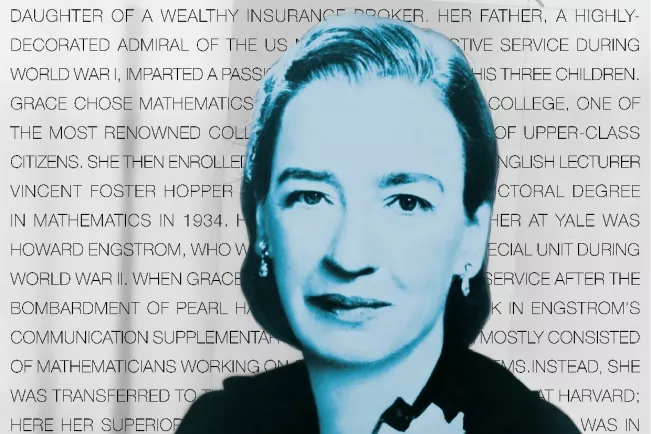
Biography Grace Hopper (1906-1992)
Grace Brewster Murray is born on 9 December 1906 in New York, the daughter of Mary Campbell Van Horne and Walter Fletcher Murray, a wealthy insurance broker. Her father, a highly decorated admiral in the US Navy during the First World War, instils a passion for mathematics in his three children. Grace choses mathematics as her major at Vassar College, one of the most prestigious schools for upper-class daughters. She then enrols at Yale University, marries English lecturer Vincent Foster Hopper in 1930 and earns her doctorate in mathematics in 1934. Her most influential teacher at Yale is Howard Engstrom, who leads a special unit as a commander in World War II. When Grace volunteers for military service after the bombing of Pearl Harbour, she hopes to work in Engstrom's unit, ‘Communication Supplementary Activities,’ where mathematicians are primarily engaged in cryptography problems.
Instead, she is assigned to the Bureau of Ships Communication in Harvard, where her supervisor is reserve officer Howard Aiken – essentially the commander of Mark I, one of the first primitive computers developed by the Navy. Aiken tasks Grace Hopper with calculating firing tables for a new type of rocket within a very short time frame. Grace solves the problem and, in two years, programs a total of 23 such tables for the Navy's ballistics experts. As one of only three programmers, she is then commissioned by Aiken to write a user manual for the Mark I.
Her work on the Mark I and its successor, the Mark II, leaves a lasting impression on Grace Hopper. After the war and the death of her husband, she initially returns to Vassar College as a professor of mathematics. Seeing no further opportunities for advancement there, she moves to Eckert-Mauchly Computer Corporation, where work is underway on the first commercially produced computer, called UNIVAC I. In the 1950s and 1960s, she develops a compiler and eventually the COBOL programming language. She turns down a job at IBM. She actively participates in all reserve officer training exercises, but is discharged from the army in 1966, which upsets her greatly.
The Vietnam War brings a turning point: on 1 August 1967, she is drafted again and, together with her team, is tasked with standardising the various programming languages used by the US Navy. The project, for which Grace Hopper uses COBOL as the target language, is estimated to take six months, but she stays for 19 years. In 1986, she is discharged from military service but continues to work as a consultant to the Navy until her death.
On New Year's Day 1992, Grace Hopper dies in her sleep, though as a programmer she would have loved to see 31 December 1999: in the 1950s, it was Hopper's decision to limit the date function in COBOL to two digits for the year. At the time, no one expected COBOL programmes to still be in use after 2000, and thus no one anticipated that a serious computer problem would arise at the turn of the year, which would go down in history as the ‘millennium bug’.
Sponsoring

Conet sponsored the portrait of Grace Hopper and supported the exhibition Visionary female researchers with a donation of €3,000.
Contact points
Centre for Science and Technology Transfer (ZWT)
Campus
Sankt Augustin