30 years Hochschule Bonn-Rhein-Sieg
Exhibition Visionary Female Researchers: Laura Bassi
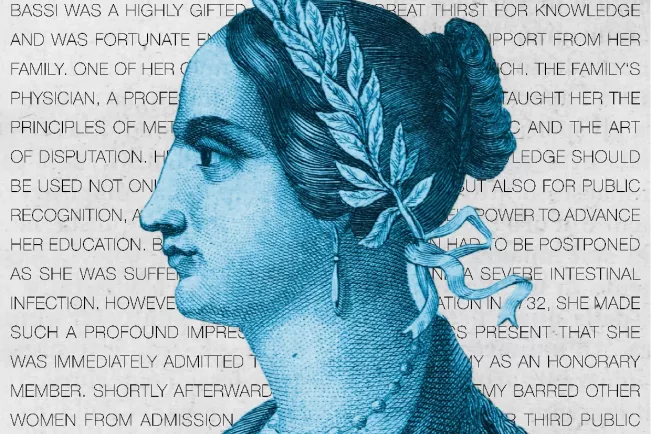
Biography Laura Bassi (1711-1778)
Laura Bassi is born in Bologna on 29 October 1711, the only surviving child of lawyer Giuseppe Bassi and his wife Rosa Cesarei.
Bassi is a particularly inquisitive and gifted child and is given extensive support by her family. A cousin teaches her Latin and French. The family's doctor, a professor of philosophy and medicine, teaches her the basics of metaphysics, natural philosophy and logic, and instructs her in the art of disputation. Her parents agree that the knowledge she acquires should serve not only her inner edification but also her public recognition and therefore support her education to the best of their ability.
Bassi's first private disputation has to be postponed due to an eye disease and a severe intestinal infection. However, in a second disputation in 1732, she impresses the scholars so much that she is immediately accepted as an honorary member of the Bologna Academy. Shortly afterwards, however, the academy refuses to admit any more women.
In June 1732, Bassi holds her third public disputation, in which she qualifies as a professor with her natural philosophical observations on water. Her advocates campaign for her to be appointed to a chair in philosophy at the University of Bologna, even though she has not yet reached the minimum age requirement. With an annual salary of five hundred lire, Laura Bassi becomes the first female university professor in Europe. However, there is one restriction for Bassi: because of her gender, she is only allowed to give public lectures at the behest of the authorities. Her colleagues themselves reject women.
Due to her limited lecturing rights, Laura Bassi gives lectures at her home, and her private lectures are very well attended. She now focuses primarily on the natural sciences: mechanics, hydrodynamics, pneumatics, optics and electricity are her areas of expertise. After her father's death in 1738, she chooses the young, penniless physician Giuseppe Verati as her husband. The two got to know each other better during a series of experiments and respect and appreciate each other. Laura Bassi gives birth to eight children, five of whom survive infancy.
Bassi devotes herself to the natural sciences with increasing passion and conducts numerous experiments, some of them in her own observatory. In addition to her care work as a housewife and mother, she continues her scientific research. She makes a name for herself as an experimental physicist and conducts research into the phenomenon of electricity. During her research, the first lightning conductors are installed at the Bologna Academy.
Thanks to a reform by Pope Benedict XIV, the Bologna Academy is recognised as a highly respected institution since 1745. As a native of Bologna, Pope Benedict ensures that Laura Bassi is accepted into the circle of the so-called Benedettini, an elite group of researchers at the Academy with a fixed annual salary. This is a great success for Bassi, even though she does not enjoy equal rights as a woman: unlike her colleagues, she is not allowed to vote in the election of new Academy members.
In 1772, a physics professorship becomes available at the academy. Despite her outstanding achievements, Bassi is not considered for the position; instead, her husband is appointed. It is not until four years later that she receives the professorship. The fact that she is finally appointed in 1776 is thanks to her tenacity, the goodwill of some of her colleagues and the loyalty of her husband, who declines the professorship and is content to take on the role of deputy.
Only two years after her appointment, Laura Bassi, who had suffered from health problems throughout her life, dies of heart failure on 20 February 1778 at the age of 67. On 5 October 2017, the asteroid (15742) Laurabassi is named after her.
Sponsoring

Eaton sponsored the portrait of Laura Bassi and supported the exhibition Visionary Women Researchers with a donation of €3,000.
Contact points
Centre for Science and Technology Transfer (ZWT)
Campus
Sankt Augustin