30 years Hochschule Bonn-Rhein-Sieg
Exhibition Visionary Female Researchers: Marie Curie
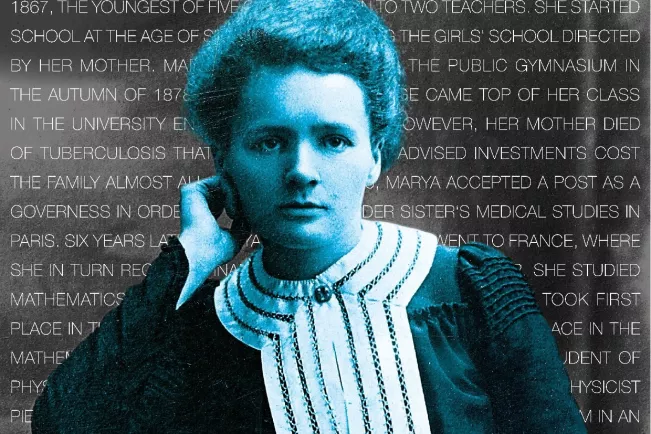
Biography Marie Curie (1867-1934)
On 7 November 1867, Marie Curie is born Marya Sklodowska, the youngest of five children of Bronislawa and Wladyslaw Sklodowska, a married couple who are both teachers, in Warsaw. At the age of six, she starts school and initially attends the girls' school run by her mother. In the autumn of 1878, Marya transfers to a public secondary school and, at the age of 15, passes her school-leaving examination as the best in her class. In 1878, her mother dies of tuberculosis, and the family loses almost its entire fortune due to bad investments. Marya then takes a job as a governess in 1885 to finance her older sister's medical studies in Paris. At that time, women are not allowed to study in Poland.
Six years later, Marya Sklodowska follows her sister to France, who now supports her financially. She studies mathematics and physics at the Sorbonne in Paris and comes first in her final physics exam. She comes second in her final mathematics exam and subsequently becomes a doctoral student of physics professor Antoine Henri Becquerel.
On 25 July 1895, she marries physicist Pierre Curie and from then on works with him in a makeshift laboratory under extremely inadequate conditions. Curie is convinced that the radiation of the element uranium, discovered by Becquerel in the same year, can also be detected in other elements. She isolates the previously unknown elements radium and polonium and coins the term ‘radioactive’ for their radiation. Marie Curie names the element polonium after her home country of Poland.
In 1897, Marie Curie gives birth to her daughter Irène, and the following year she discovers the radioactivity of the element thorium. She teaches physics at the École Normale Supérieure for girls in Sèvres, where she introduces the method of experimental demonstration into her lessons. In 1903, she obtains her doctorate in physics and, in December, receives the Nobel Prize in Physics together with Henri Becquerel and her husband Pierre Curie ‘for their development and pioneering work in the field of spontaneous radioactivity and radiation phenomena’. She publishes her dissertation, ‘Research on Radioactive Substances’, at around the same time; it is translated into five languages within a year.
In 1904, Marie gives birth to her daughter Ève. In 1906, she suffers a terrible blow when Pierre Curie is killed in a tram accident on 19 April. The scientist and mother of two small children is in poor health herself. To secure her livelihood, she continues her husband's lectures at the University of Paris, becoming the first woman to teach at the Sorbonne. She spends most of her time with her daughters in the laboratory. In 1908, she is appointed full professor of physics at the Sorbonne and in 1911 is awarded the Nobel Prize in Chemistry for isolating the element radium. To this day, she remains the only woman among a total of five people worldwide to have been awarded a Nobel Prize twice in her lifetime. Nevertheless, her colleagues refuse to admit her to the French Academy of Sciences in 1911. In the same year, Marie Curie is appointed director of the Radium Institute by the Sorbonne.
Together with her daughter Irène, she develops a mobile X-ray station during the First World War, which enables injured soldiers to be examined on site. From 1918 to 1927, she conducts research with her daughter at the Radium Institute in Paris and, under her leadership, develops the institute into a centre for nuclear physics. Curie gives lectures in Brazil, Spain, Belgium and Czechoslovakia. Accompanied by her two daughters, she travels to the United States. In 1921, the President of the United States, Warren G. Harding, presents her with a gram of radium as a symbolic recognition of her research, the purchase of which was financed by donations from American women. Curie focuses her chemical investigations of radioactive substances specifically on medical applications to tap into the potential of radioactivity for curing diseases.
On 4 July 1934, Marie Curie dies in Sancellemoz, Switzerland, of leukaemia, probably caused by excessive doses of radioactive radiation during her work. The bodies of Marie Curie and her husband are buried in the Panthéon in Paris.
Sponsoring

C. Gerhardt sponsored the portrait of Marie Curie and supported the exhibition Visionary female researchers with a donation of €3,000.
C. Gerhardt GmbH & Co. KG is a fifth-generation family-run company based in Königswinter. Since 1846, we have been developing and producing laboratory equipment that provides food and feed manufacturers with reliable data for nutritional information – for example, to determine the protein content in milk, meat or other foods.
As a regional employer, we offer secure jobs, modern training and development opportunities, and a friendly working environment. Precision, quality and team spirit characterise our everyday work – from the construction of the equipment to global customer service.
We actively expand our many years of expertise through cooperation with scientific institutes and universities. At the same time, it is important to us to share our knowledge with the world. Through our cooperation with the Bonn-Rhein-Sieg University of Applied Sciences, we support the practical training of young people and the transfer of knowledge to young professionals from the region.
Contact points
Centre for Science and Technology Transfer (ZWT)
Campus
Sankt Augustin