Department of Engineering and Communication
Digital Communication and Media Innovation (MA)

Study Facts
Degree
Master's degree
Standard period of study
3 semester
Lecture language
German
Campus
Sankt Augustin
Start of study
Summer term
Type of study
Full-time
Admission requirements
Admission to the programme requires a first professional higher education qualification in which at least 210 credit points have been earned. You will also need to submit examples of your work or publications with your application. Applicants from other disciplines who have not completed a degree in media and communication studies must provide evidence of at least six months’ professional experience in a media-related field.
Admission type and application deadline
If you fulfil all the admission requirements, you can enrol within the deadline. You can apply between November 15 to March 15 for the summer semester.
Language skills
The programme is German. Elective modules may also be in English. German language skills at level C1 (CEFR) are required, demonstrated by a German university entrance qualification or the following German language certificates: German language certificates.
Costs
Only the current semester fee is payable for this degree programme: Semester fees and Administrative fees.
Programme Content and qualification objective
Study plan
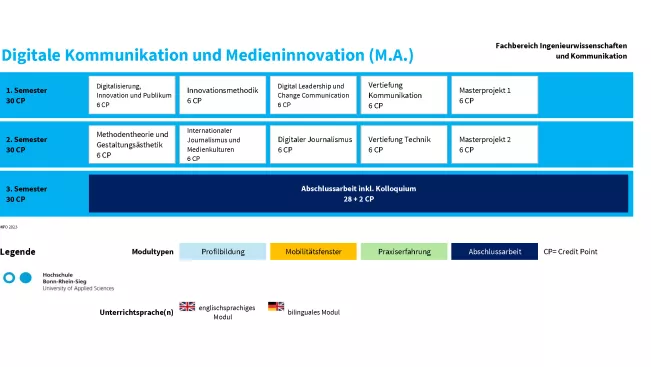
The degree programme lasts three semesters. In the first semester, students acquire a grounding in digital transformation, innovation methods, digital leadership and change communication, and deepen their knowledge of journalism and communication. The second semester focuses on media theory, design aesthetics, international and digital journalism, data journalism and artificial intelligence. In the third semester, students complete the programme with their Master’s thesis and the colloquium.
Prospects and job opportunities
The Master’s programme prepares students for careers in media organisations, agencies, companies and the digital and creative industries. Graduates go on to work in fields such as digital journalism, corporate communications, content and format development, project management, and audience and UX management. They combine journalistic, communication and data-driven skills with innovative methodologies and are well-equipped to successfully manage digital media and communication projects.
Practical relevance and teaching formats
The degree programme consistently combines academic knowledge with practical teaching methods. Practical work takes place, amongst other places, in the university’s own TV and radio studios. In their Master’s projects, students work independently on research or development projects, from conception through to implementation and the presentation of results. Collaborations with industry partners from renowned media organisations complement the programme by addressing current issues in media and communication.
Study location and learning environment
Hochschule Bonn-Rhein-Sieg has its own TV and radio studios, which are equipped to the highest technical standards for producing professional audio and video content. It also has a newsroom and a print editorial office.
The town of Sankt Augustin, home to the university’s campus, borders the city of Bonn to the north-east. The state university is easily accessible by public transport from Cologne, Bonn, Düsseldorf or Koblenz. The campus is modern, and the classrooms, laboratories, workshops and library are excellently equipped. Small study groups facilitate good interaction with fellow students and lecturers. The university has a strong network and cooperates with around 90 foreign universities in more than 40 countries.
Study plan
Accreditation
Head of degree programme

Location
Sankt Augustin
Room
B 287
Address
Grantham-Allee 20
53757 Sankt Augustin
Telephone
+49 2241 865 9627Contact points
Course guidance service Master Digital Communication and Media Innovation
Campus
Sankt Augustin
Room
B287
Opening hours
We look forward to hearing from you.
Contact to the Student Services
Opening hours
Telephone consultation hours: Monday - Friday: 10:00 - 12:00
Personal consultations by appointment only
Contact Student Advice Centre
Campus
Sankt Augustin
Room
E029, E031, E034, E035, E041
Opening hours
Telephone hours without appointment
Telephone hours: Monday, Wednesday and Thursday: 10:00-12:00
and Monday: 13:00-15:00
International Office - Sankt Augustin
Campus
Sankt Augustin
Room
E 056 - E 061
Opening hours
Please contact us by phone or email for an appointment