International Centre for Sustainable Development (IZNE)
reTURN project meeting at Caphenia: Tour of the renewable fuel reactor
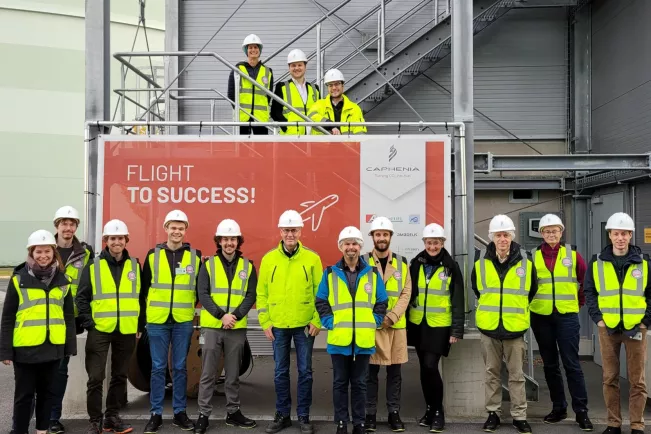
The aim of the reTURN project partners is to revolutionise the transport sector by integrating various industries. The aim is to develop a process for the production of environmentally friendly synthetic fuels (synFuels) at economically viable costs.
At this year's project meeting, the IZNE scientists discussed the current status with the Caphenia project partners:
A basic model has now been developed at the IZNE that can be used to compare different methods for the production of synthetic fuel (synFuel). The focus is on fuels that use carbon monoxide (CO) and hydrogen (H₂) as starting materials, also known as synthesis gas. This synthesis gas is then further processed using what is known as Fischer-Tropsch synthesis.
The model takes three different pathways into account:
- Bio-to-Liquid (BtL): Here, biomass (e.g. wood or plant residues) is used as a fuel. (e.g. wood or plant residues) is pyrolysed and converted into gas.
- Power-to-Liquid (PtL): Here, electrical energy is used to generate hydrogen using electrolysis. The CO is produced from carbon dioxide (CO2), which is captured either directly from the air or from industrial waste gases.
- Power-and-(Bio)gas-to-Liquid (PBtL): Here, the synthesis gas is produced from (bio)gas (methane and CO2) in a special reactor. The modelled reactor is based on the plant built in Frankfurt Höchst by project partner CAPHENIA.
The life cycle assessment (LCA) is used to calculate the extent to which the various processes impact the climate. All steps from raw material extraction to flight are considered (well-to-wing).
First results show:
- The climate impact of the PBtL method for the German electricity mix is significantly lower than for PtL and also lower than for BtL.
- The emissions during production depend heavily on the electricity used.
- The total emissions (from raw material extraction to flight) are mainly influenced by the origin and handling of the carbon.
The model developed by IZNE therefore helps to find the most environmentally friendly method for fuel production. The reTURN project has already been running for three years. Now that the modelling has largely been completed, the coming year will be used to verify and publish the results.

Contact us

Stefanie Meilinger
Professor for Sustainable Technologies, esp. Energy Efficiency and Renewable Energies, Director of the International Centre for Sustainable Development (IZNE), Department Engineering and Communication (IWK)
Research fields
Location
Sankt Augustin
Room
F 321
Address
Grantham-Allee 20
53757 Sankt Augustin
Telephone
+49 2241 865 718Contact points
Kontakt: Internationales Zentrum für Nachhaltige Entwicklung (IZNE)
Campus
Sankt Augustin