Institute of Technology, Resource and Energy-efficient Engineering (TREE)
Multiscale Molecular Modelling Center
„Creating and using models have a long history in scientific research and education. Computational chemistry is an exciting field that requires cross-disciplinary knowledge to build realistic and trustworthy models. Because of this, one always has the opportunity to learn something new, apply ideas from one field to others, and create new knowledge at incredible resolution levels.”
Dr. Karl N. Kirschner

Research Overview
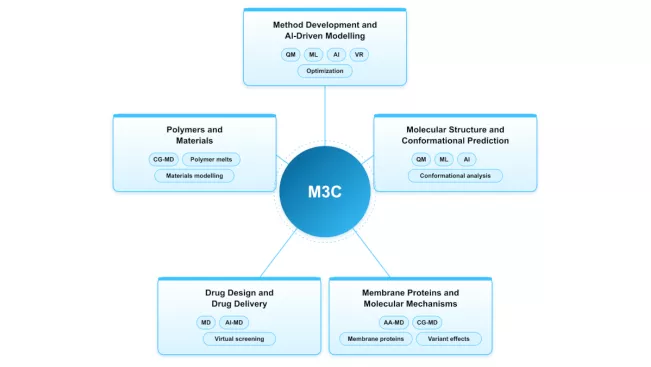
Overview of the center's topics and methods.
Method Development & AI Data-Driven Modelling
The central pillar of our research is the development and refinement of physics-based and data-driven methods. In force-field optimization, we focus on formulating tailored loss functions, tuning weighting parameters, and leveraging multi-objective optimization algorithms that preserve physical validity. Concurrently, we harness modern machine learning (ML) to explore complex parameter landscapes (utilizing advanced techniques like quality-diversity optimization), train surrogate models for molecular dynamics, and predict high-dimensional potential energy surfaces. We also apply ML to evaluate molecular similarity, generating novel hypotheses for experimental validation (e.g., drug repurposing). To maximize computational efficiency, we integrate data-driven models directly with quantum mechanical calculations to build hybrid ML → QM workflows.
Topics & Projects
- Force field & method development: loss functions, weighting factors, multi-objective optimization
- Correlation functions and optimization of the potential energy surface (PES)
- Method development and application of partial atomic charges, including the modeling of anisotropic electrostatics (σ -hole, electron lone-pairs)
- Multi-objective and quality-diversity optimization of the Lennard-Jones parameter landscape
- ML→QM workflow methodology
- AI-driven modelling and generative methods
- Visualization & teaching: virtual reality in teaching, proteins/MD in public outreach and as a video game
- Education: SciPro course; boiling points using ML with Jupyter Notebook
Molecular Structure & Conformational Prediction
Our group also predicts the molecular structures and conformations of small molecules. We explore conformational space by systematically rotating torsion angles, performing QM optimizations, and by integrating modern generative ML methods. For example, we embed QM calculations directly into the conformational search — enabling end-to-end ML → QM workflows that are applied to complex biopolymers (e.g., lignin). Our research investigates fundamental conformational phenomena, including ring-puckering dynamics in small cycles (e.g., cyclopentane), conformer ensembles for flexible hydrocarbons (e.g., octane), and σ-hole interactions between halogenated compounds and various organic molecules.
Topics & Projects
- AI-driven structure & conformational prediction of small molecules: benchmarking modern generative AI methods
- Extension of the conformational dataset (QM) for ML training
- QM in conformational generation for lignin
- ML→QM workflow methodology
- Cyclopentane ring puckering
- Nonane QM conformers
- Applications of force field development: 1-bromobutane, 2-bromobutane and extension to Cl, F, Br, I
- Br-substituted benzene – water interactions (QM)
Membrane Proteins & Molecular Mechanisms
Molecule Dynamics Modelling
A major focus of our research is investigating membrane proteins and understanding their underlying molecular mechanisms. Using all-atom and coarse-grained molecular dynamics (AA-MD and CG-MD), we analyze the structure, dynamics, and function of membrane transport and receptor systems — including the nicotinic acetylcholine receptor (nAChR) across distinct functional states, the sodium-proton exchanger NHE1, and organic cation (OCT) transporters. Our work also encompasses characterizing potential substrates for monocarboxylate transporter 1 (MCT1) to elucidate their role in congenital metabolic disorders.
Variant Effect Prediction & Cross-Species Modeling
Beyond direct molecular simulations, we develop ML models for variant effect prediction (VEP). We examine missense variant functional consequences across species boundaries (e.g., in ENaC and nAChR) and extend curated human VEP datasets by integrating data from mouse and rat models. This cross-species perspective helps bridge sparse-data gaps and improves predictive power.
Topics & Projects
- Membrane proteins & molecular mechanisms: nAChR (AA-MD, CG-MD; resting state 7KOO, open state 7KOX), NHE1 (AA-MD), OCT transporters (AA-MD)
- Variant effects & transport proteins: variant effect prediction across species boundaries (ENaC, nAChR)
- Cross-species variant effect prediction (VEP): extension of human VEP datasets with mouse and rat data
- Characterization of potential MCT1 substrates in connection with congenital metabolic disorders
Drug Design & Drug Delivery
Our group researches computer-aided strategies towards drug design and drug delivery. One focus is the analysis of structure-activity relationships and virtual screening — leveraging our custom MolFuSE framework. In drug delivery, we investigate carrier-mediated transport and controlled release mechanics, with a special emphasis on modeling cyclodextrin complexes. We study these systems using hybrid ML-driven molecular dynamics simulations (ML-MD) to bridge theoretical predictions with empirical data.
Topics & Projects
- Drug design & virtual screening: analysis of structure-activity relationships and virtual screening using the MolFuSE method
- Drug delivery & cyclodextrins: concepts of drug design and delivery as well as modelling of cyclodextrins using AI-driven molecular dynamics (AI-MD)
Polymers & Materials
A further research area is dedicated to the modelling of polymers and materials. The focus is on the investigation of polymer melts, in particular of high-density polyethylene (HDPE) for extrusion blow moulding, which is simulated using coarse-grained molecular dynamics (CG-MD). These efforts are extended to additives and to polypropylene (PP). In addition, modified membranes are analytically characterized and structurally interpreted.
Topics & Projects
- Polymers & materials: polymer melts of high-density polyethylene (HDPE) for extrusion blow moulding (CG-MD) with extension to additives and polypropylene (PP)
- Analytical characterization of modified membranes: structural interpretation of modified membrane systems
Labs

The calculations are performed on the high-performance computing cluster at Bonn-Rhein-Sieg University of Applied Sciences. Opportunities for efficient parallelization, combined with state-of-the-art simulation tools, enable highly detailed calculations.
Teaching

As part of the UMMBAS research project, the group is working on the development of a collaborative VR environment to enable efficient collaboration on topics in the field of molecular modeling across geographical boundaries. Once the collaboration concepts under development are established, they are expected to be applicable in teaching as well. In particular, they could be used in teaching modules offered across departments or universities.









Alumni
Partners
- Edward E. Whitacre Jr. College of Engineering, Texas Tech University (Prof. Dr. Roland Faller)
- Institut für Integrierte Naturwissenschaften, Universität Koblenz (Prof. Dr. Wolfgang Imhof)
- Institut für Prozess- und Verfahrenstechnik, Technische Universität Berlin (Prof. Dr. Jadran Vrabec)
- Department of Chemistry, Furman University, South Carolina (Prof. Dr. George Shields)
- Division of Hematology, Ohio State University, Comprehensive Cancer Center, Columbus, OH USA (Prof. Drs. John Byrd and Karilyn Larkin)
Selected Publications
Arbeitsgruppe Computational Chemistry
2026
Karl N. Kirschner:
Extending the Python RESP Framework for Extra Point Charge Fitting.
doi:10.1021/acs.jcim.6c02302 PMID
BibTeX | RIS
Alexander Hagg, Dirk Reith, Matthias Preller, Karl N. Kirschner:
Molecular Function-guided Unsupervised Similarity-based Enrichment for Low-Data Virtual Screening.
doi:10.21203/rs.3.rs-9781932/v1
BibTeX | RIS
Robin Paul Strickstrock:
Automatized Multi-Scale Force-Field Parameter Optimization of Lennard-Jones Parameters for Molecular Dynamics Simulations.
doi:10.82549/OPUS4-2647
BibTeX | RIS
Bastian F. Bundschuh, Franziska Kley, Hebah Fatafta, Birgit Strodel:
All-atom MD simulations of amyloid–membrane interactions: Setup, execution, and analysis.
doi:10.1016/bs.mie.2026.01.031 PMID
BibTeX | RIS
Kacper Rzepiela, Yousef Najajreh, Aneta Buczek, Birgit Strodel, Hebah Fatafta:
Molecular Insights into the Incorporation of Platinum-Based Drugs into Lipid Aggregates.
PDF Download (CC-BY 4.0) doi:10.1021/acsomega.5c11203 urn:nbn:de:hbz:1044-opus-94730 PMID
BibTeX | RIS
2025
Anna Leitz, Batuhan Kav, Xiyang Liu, Hebah Fatafta, Vera Jankowski, Bastian Aggeler, Yingying Gao, Ina Verena Martin, Kristian Vogt, Rafael Kramann, Tammo Ostendorf, Thomas Rauen, Birgit Strodel, Ute Raffetseder:
Guanidinylation of the cold shock protein YB-1: Molecular basis, structural changes and Notch-3 receptor binding.
doi:10.1002/pro.70188 PMID
BibTeX | RIS
Dirk Grommes, Olaf Bruch, Wolfgang Imhof, Dirk Reith:
Coarse-Grained Molecular Dynamics Study of the Melting Dynamics in Long Alkanes.
PDF Download (CC BY 4.0) doi:10.3390/polym17182500 PMID urn:nbn:de:hbz:1044-opus-92378
BibTeX | RIS
Robin Strickstrock, Alexander Hagg, Dirk Reith, Karl N. Kirschner:
Speed up Multi-Scale Force-Field Parameter Optimization by Substituting Molecular Dynamics Calculations with a Machine Learning Surrogate Model.
PDF Download (CC BY 4.0) doi:10.1002/cphc.202500353 PMID urn:nbn:de:hbz:1044-opus-92140
BibTeX | RIS
Karl N. Kirschner:
Gas-Phase Benzene-Methanol Dimer Configurations: Geometries, Relative Stabilities, and Interaction Energies.
PDF Download (CC BY-NC-ND 4.0) doi:10.1021/acs.jpca.5c03923 PMID urn:nbn:de:hbz:1044-opus-91857
BibTeX | RIS
Robin Strickstrock, Alexander Hagg, Marco Hülsmann, Karl N. Kirschner, Dirk Reith:
Fine-tuning property domain weighting factors and the objective function in force-field parameter optimization.
PDF Download (CC BY 4.0) doi:10.1016/j.jmgm.2025.109035 PMID urn:nbn:de:hbz:1044-opus-90066
BibTeX | RIS
Aneta Buczek, Kacper Rzepiela, Malgorzata A. Broda, Teobald Kupka, Birgit Strodel, Hebah Fatafta:
Water modulated influence of intramolecular hydrogen-bonding on the conformational properties of Cannabidiol (CBD).
doi:10.1016/j.molliq.2025.127033
BibTeX | RIS
2024
Hebah Fatafta, Mohammed Khaled, Batuhan Kav, Olujide O. Olubiyi, Birgit Strodel:
A brief history of amyloid aggregation simulations.
doi:10.1002/wcms.1703
BibTeX | RIS
Dirk Grommes:
Untersuchung des mikromechanischen Verhaltens von Polyethylen mittels vergröberter Molekulardynamik Simulationen.
URL
BibTeX | RIS
Dirk Grommes, Olaf Bruch, Dirk Reith:
Mimicking Polymer Processing Conditions on the Meso-Scale: Relaxation and Crystallization in Polyethylene Systems after Uni- and Biaxial Stretching.
PDF Download (CC BY 4.0) doi:10.3390/molecules29143391 PMID urn:nbn:de:hbz:1044-opus-85233
BibTeX | RIS
2023
Eva Smorodina, Batuhan Kav, Hebah Fatafta, Birgit Strodel:
Effects of ion type and concentration on the structure and aggregation of the amyloid peptide A β16-22.
doi:10.1002/prot.26635 PMID
BibTeX | RIS
Alexander Hagg, Karl N. Kirschner:
Open-Source Machine Learning in Computational Chemistry.
PDF Download (CC BY-NC-ND 4.0) doi:10.1021/acs.jcim.3c00643 PMID urn:nbn:de:hbz:1044-opus-74406
BibTeX | RIS
Max Müller, Alexander Hagg, Robin Strickstrock, Marco Hülsmann, Alexander Asteroth, Karl N. Kirschner, Dirk Reith:
Determining Lennard-Jones Parameters Using Multiscale Target Data through Presampling-Enhanced, Surrogate-Assisted Global Optimization.
doi:10.1021/acs.jcim.2c01231 PMID
BibTeX | RIS
JinHeng Lin, Sean M. Gettings, Khaoula Talbi, Rainer Schreiber, Michael J. Taggart, Matthias Preller, Karl Kunzelmann, Mike Althaus, Michael A. Gray:
Pharmacological inhibitors of the cystic fibrosis transmembrane conductance regulator exert off-target effects on epithelial cation channels.
PDF Download (CC BY 4.0) doi:10.1007/s00424-022-02758-9 PMID urn:nbn:de:hbz:1044-opus-64572
BibTeX | RIS
2022
Lucie Khemtemourian, Hebah Fatafta, Benoit Davion, Sophie Lecomte, Sabine Castano, Birgit Strodel:
Structural Dissection of the First Events Following Membrane Binding of the Islet Amyloid Polypeptide.
doi:10.3389/fmolb.2022.849979 PMID
BibTeX | RIS
Dirk Grommes, Martin R. Schenk, Olaf Bruch, Dirk Reith:
Initial Crystallization Effects in Coarse-Grained Polyethylene Systems After Uni- and Biaxial Stretching in Blow-Molding Cooling Scenarios.
PDF Download (CC BY 4.0) doi:10.3390/polym14235144 PMID urn:nbn:de:hbz:1044-opus-65219
BibTeX | RIS
Walter Fiedler, Fabian Freisleben, Jasmin Wellbrock, Karl N. Kirschner:
Mebendazole's Conformational Space and Its Predicted Binding to Human Heat-Shock Protein 90.
doi:10.1021/acs.jcim.2c00290 PMID
BibTeX | RIS
Robin Strickstrock, Marco Hülsmann, Dirk Reith, Karl N. Kirschner:
Optimizing Lennard-Jones parameters by coupling single molecule and ensemble target data.
doi:10.1016/j.cpc.2022.108285
BibTeX | RIS
2021
Hebah Fatafta, Batuhan Kav, Bastian F. Bundschuh, Jennifer Loschwitz, Birgit Strodel:
Disorder-to-order transition of the amyloid-β peptide upon lipid binding.
doi:10.1016/j.bpc.2021.106700 PMID
BibTeX | RIS
Hebah Fatafta, Mohammed Khaled, Michael C. Owen, Abdallah Sayyed-Ahmad, Birgit Strodel:
Amyloid-β peptide dimers undergo a random coil to β-sheet transition in the aqueous phase but not at the neuronal membrane.
doi:10.1073/pnas.2106210118 PMID
BibTeX | RIS
Hebah Fatafta, Suman Samantray, Abdallah Sayyed-Ahmad, Orkid Coskuner-Weber, Birgit Strodel:
Molecular simulations of IDPs: From ensemble generation to IDP interactions leading to disorder-to-order transitions.
doi:10.1016/bs.pmbts.2021.06.003 PMID
BibTeX | RIS
Dirk Grommes, Martin R. Schenk, Olaf Bruch, Dirk Reith:
Investigation of Crystallization and Relaxation Effects in Coarse-Grained Polyethylene Systems after Uniaxial Stretching.
PDF Download (CC BY 4.0) doi:10.3390/polym13244466 PMID urn:nbn:de:hbz:1044-opus-60472
BibTeX | RIS
2020
Hebah Fatafta, Chetan Poojari, Abdallah Sayyed-Ahmad, Birgit Strodel, Michael C. Owen:
Role of Oxidized Gly25, Gly29, and Gly33 Residues on the Interactions of Aβ1-42 with Lipid Membranes.
doi:10.1021/acschemneuro.9b00558 PMID
BibTeX | RIS
Meera C. Viswanathan, William Schmidt, Peter Franz, Michael J. Rynkiewicz, Christopher S. Newhard, Aditi Madan, William Lehman, Douglas M. Swank, Matthias Preller, Anthony Cammarato:
A role for actin flexibility in thin filament-mediated contractile regulation and myopathy.
doi:10.1038/s41467-020-15922-5 PMID
BibTeX | RIS
Wiebke Ewert, Peter Franz, Georgios Tsiavaliaris, Matthias Preller:
Structural and Computational Insights into a Blebbistatin-Bound Myosin•ADP Complex with Characteristics of an ADP-Release Conformation along the Two-Step Myosin Power Stoke.
PDF Download (CC BY 4.0) doi:10.3390/ijms21197417 urn:nbn:de:hbz:1044-opus-50854 PMID
BibTeX | RIS
Andrea Cesari, Gloria Uccello Barretta, Karl N. Kirschner, Matteo Pappalardo, Livia Basile, Salvatore Guccione, Clizia Russotto, Maria Rosaria Lauro, Francesca Cavaliere, Federica Balzano:
Interaction of natural flavonoid eriocitrin with β-cyclodextrin and hydroxypropyl-β-cyclodextrin: an NMR and molecular dynamics investigation.
doi:10.1039/D0NJ02022B
BibTeX | RIS
Karl N. Kirschner, Dirk Reith, Wolfgang Heiden:
The performance of Dunning, Jensen, and Karlsruhe basis sets on computing relative energies and geometries.
doi:10.1080/1539445x.2020.1714656
BibTeX | RIS
Dirk Grommes, Dirk Reith:
Determination of relevant mechanical properties for the production process of polyethylene by using mesoscale molecular simulation techniques.
doi:10.1080/1539445x.2020.1722692
BibTeX | RIS
Martin R. Schenk, Thorsten Köddermann, Karl N. Kirschner, Sandra Knauer, Dirk Reith:
Molecular Dynamics in the Energy Sector: Experiment and Modeling of the CO2/CH4 Mixture.
doi:10.1021/acs.jced.9b00503
BibTeX | RIS
2019
Austen Bernardi, Roland Faller, Dirk Reith, Karl N. Kirschner:
ACPYPE update for nonuniform 1–4 scale factors: Conversion of the GLYCAM06 force field from AMBER to GROMACS.
doi:10.1016/j.softx.2019.100241
BibTeX | RIS
2018
Dirk Reith, Johannes Geilen, Wolfgang Joppich, Olaf Bruch, Bernhard Möginger, Esther Ramakers-van Dorp, Dirk Grommes, Patrick Michels, Christopher Schirrmeister:
Ressourcenoptimierte Bauteilentwicklung durch systematische Verzahnung von Experiment und multiskaligen Simulationsansätzen, Akronym: ReBauVES: Abschlussbericht.
doi:10.2314/KXP:1668297248
BibTeX | RIS
Jadran Vrabec, Martin Bernreuther, Hans-Joachim Bungartz, Wei-Lin Chen, Wilfried Cordes, Robin Fingerhut, Colin W. Glass, Jürgen Gmehling, René Hamburger, Manfred Heilig, Matthias Heinen, Martin T. Horsch, Chieh-Ming Hsieh, Marco Hülsmann, Philip Jäger, Peter Klein, Sandra Knauer, Thorsten Köddermann, Andreas Köster, Kai Langenbach, Shiang-Tai Lin, Philipp Neumann, Jürgen Rarey, Dirk Reith, Gábor Rutkai, Michael Schappals, Martin R. Schenk, Andre Schedemann, Mandes Schönherr, Steffen Seckler, Simon Stephan, Katrin Stöbener, Nikola Tchipev, Amer Wafai, Stephan Werth, Hans Hasse:
SkaSim - Skalierbare HPC-Software für molekulare Simulationen in der chemischen Industrie.
doi:10.1002/cite.201700113
BibTeX | RIS
Karl N. Kirschner, Wolfgang Heiden, Dirk Reith:
Small Alcohols Revisited: CCSD(T) Relative Potential Energies for the Minima, First- and Second-Order Saddle Points, and Torsion-Coupled Surfaces.
PDF Download doi:10.1021/acsomega.7b01367 urn:nbn:de:hbz:1044-opus-34995 PMID
BibTeX | RIS
2017
Martin R. Schenk, Karl N. Kirschner, Dirk Reith:
Kraftfeldentwicklung für molekulare Simulationen – Einfluss der Auswahl verschiedener Punktladungssätze auf potentielle Energien und ausgewählte thermodynamische Observablen.
BibTeX | RIS
Marco Hülsmann, Bernhard Klaassen, Andreas Krämer, Ottmar Krämer-Fuhrmann, Tosawi Pangalela, Dirk Reith, Klaus Hack, Johannes Linden:
Calculation of Chemical Equilibria in Multi-Phase: Multicomponent Systems.
doi:10.1007/978-3-319-62458-7_1
BibTeX | RIS
Thorsten Köddermann, Martin R. Schenk, Marco Hülsmann, Andreas Krämer, Karl N. Kirschner, Dirk Reith:
Molecular Dynamics Simulation of Membrane Free Energy Profiles Using Accurate Force Field for Ionic Liquids.
doi:10.1007/978-3-319-62458-7_14
BibTeX | RIS
Sandra Knauer, Martin R. Schenk, Thorsten Köddermann, Dirk Reith, Philip Jaeger:
Interfacial Tension and Related Properties of Ionic Liquids in CH4 and CO2 at Elevated Pressures: Experimental Data and Molecular Dynamics Simulation.
doi:10.1021/acs.jced.6b00751
BibTeX | RIS
Dirk Grommes, Olaf Bruch, Johannes Geilen, Dirk Reith:
Ressourceneffiziente Optimierung von Hohlkörpern aus Kunststoff mittels Multiskalensimulation.
URL doi:10.13140/RG.2.2.35976.62729
BibTeX | RIS
Karl N. Kirschner, Wolfgang Heiden, Dirk Reith:
Relative electronic and free energies of octane's unique conformations.
doi:10.1080/00268976.2016.1262076
BibTeX | RIS
Kontakt

Dirk Reith
Computational Science and Engineering , Managing Director of the TREE Institute, Faculty Advisor BRS Motorsport
Research fields
Location
Sankt Augustin
Room
B 223
Address
Grantham-Allee 20
53757 Sankt Augustin
Telephone
+49 2241 865 9678