Centre for Entrepreneurship, Innovation and SME Management (CENTIM)
Impact Entrepreneurship
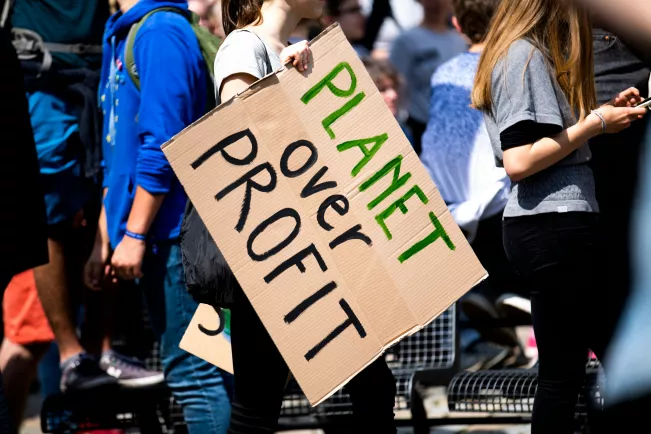
Develop and implement ideas with a social impact

Short & Brief
Explanations of important terms, distinctions and facts. So that we have a common understanding of the common good, social innovation and entrepreneurship.
What actually is ... The common good - and what does it have to do with business?
The common good describes everything that benefits society as a whole and not just individuals. It is about creating conditions in which as many people as possible can live well. This includes fundamental aspects such as
- a functioning healthcare system,
- equitable access to education,
- social security,
- an intact environment and
- democratic participation.
These areas are often seen as the responsibility of the state. However, companies also play a decisive role in how we live together as a society and therefore have an important responsibility.
"Classic" vs. public welfare-oriented business
Modern business is often focused on profit maximisation. Efficiency, scale and competition take centre stage. While this focus has undoubtedly led to innovation, prosperity and technological progress, negative effects have also emerged, including:
- the growing gap between rich and poor,
- environmental degradation and climate crisis
- global supply chains in which human rights are violated.
The more successful a company is in business, the higher the social and environmental costs - and these costs are generally not borne by the company itself, but by society.for example, if a company produces clothing at extremely low prices by exploiting cheap labour overseas and using environmentally harmful dyes, the profits remain with the company, but the social costs (poor working conditions, poverty) and ecological costs (water pollution) are borne by the general public.
This is precisely where the Economy for the Common Good comes in. Companies that follow this approach want to make a positive contribution to society - be it through their product range, their way of working or both. They can and should be financially successful. However, the decisive factor is how this success is defined: not only in euros, but also in terms of its positive impact on society. It is therefore about maximising impact rather than just maximising profit. Economic viability remains important, but is understood as a means to an end in order to achieve common goals.
Central principles of economic activity for the common good are:
- Human dignity: Everyone involved is treated respectfully and fairly.
- Solidarity and social justice: It's about fair wages, good working conditions and equal opportunities.
- Ecological sustainability: resources are used responsibly today and in the future
- Democratic co-determination: employees and other stakeholders have a say and co-decision rights.
Opportunities for young companies and founders
Many people who want to start a company today not only ask themselves the question: How do I earn money? But also: What do I want to achieve in the world? It is precisely at universities that start-up ideas emerge that go beyond pure economic success and aim to solve social problems. This is where people with diverse knowledge, new perspectives and a critical view of existing systems come together.
A business model oriented towards the common good can bring many advantages:
- Sense of purpose: The work is experienced as meaningful because it is aimed at more than one's own success. This motivates and binds teams in the long term.
- Funding opportunities: Many programmes and networks specifically support projects that are geared towards the common good.
- Credibility: A clear focus on values creates credibility with funding institutions, partners and customers.
- Future viability: Those who focus on sustainability and cooperation are better prepared for crises and social change.
Brief explanation: Difference between volunteer work, non-profit organizations, and social enterprises
Whether social commitment and economic success can be combined is a common debate. It is often assumed that social action must be carried out exclusively on a voluntary basis or without any profit-making. However, this view falls short. In fact, there is a spectrum of models that show how impact orientation and economic viability can complement each other. We highlight the differences between volunteering, charitable/non-profit organizations and social enterprises (for-profit or not-for-profit).
Three ways to achieve social impact
1. Volunteering: an invaluable contribution to civil society
Here, individuals dedicate their time and skills for a charitable purpose without any intention of making a profit. The focus is exclusively on making a direct contribution to solving problems or providing support (e.g. volunteer fire department, neighborhood assistance, mentoring programs). Volunteering is one of the foundations of our society and its idealistic impact makes it indispensable.
2. charitable organizations (non-profit): Structured impact without profit distribution
Non-profit organizations (such as registered associations, foundations or non-profit limited liability companies - gGmbHs) pursue a non-profit purpose that is defined in their articles of association and recognized for tax purposes. They are economically active, for example through donations, membership fees or the sale of services and products (e.g. operation of a youth center with participation fees, sale of fair trade products in their own world store). The key difference to profit-oriented companies is that any surpluses generated may not be distributed to private shareholders, but must be fully reinvested in the realization of the charitable purpose. Their economic activities therefore serve the mission exclusively.
3. social enterprise: Impact as the core of the business model
Social enterprises are an excellent example of how social impact and entrepreneurial activity can be combined. They are companies that solve a social or environmental problem through a sustainable business model. Their primary goal is to generate a positive impact.
-
Social enterprise without primary profit distribution (often in gGmbH form): Many social enterprises are structured in such a way that profits generated are largely or entirely reinvested in the further development of the company and the scaling of its impact. Here, financial success serves primarily as a means of increasing the social or ecological impact.
-
Social enterprises with a profit motive (social businesses): A growing number of social enterprises are consciously pursuing a profit motive. This means that they generate profits that - after covering operating costs and reinvesting in the impact - can also be distributed to founders or investors. The main difference to traditional companies here is that the social or ecological purpose is firmly anchored in the core of the business model and is not just seen as an “add-on”. The generation of profit is seen as an essential instrument for establishing and scaling the business model sustainably and thus enabling maximum and long-term social change. Examples range from inclusive catering businesses to tech start-ups for educational equality and companies in the field of renewable energies.
Conclusion: A new perspective on business and impact
The range of models clearly shows that doing good and being economically successful are no longer opposites! There are many ways to tackle social challenges with an entrepreneurial mindset. There is enormous potential to combine your innovative ideas with financial viability and thus make a lasting positive contribution to society, especially in the context of charitable start-ups.
How exactly can you use … the Social Business Model Canvas?
Anyone who wants to start a business sooner or later encounters the Business Model Canvas – a method for clearly presenting a business model on a single page. However, for social enterprises or start-up ideas focused on the common good, the classic canvas quickly reaches its limits. This is because it focuses primarily on customer benefits, not social impact.
This is exactly where the Social Business Model Canvas (SBMC) comes in. It expands the familiar structure to include key questions that are crucial for impact-oriented start-ups:
- What social challenge are we solving?
- What impact do we want to achieve – and for whom?
- How do we remain economically viable?
Impact rather than just additional value
Instead of thinking of the target group solely as “customers,” the SBMC distinguishes between beneficiaries (who have a specific problem) and customers (who may pay or provide resources). Added to this is the impact, i.e., the desired social change. This “purpose” is not a decorative accessory, but rather the core of the model.
Compared to the classic canvas or lean canvas, the SBMC therefore sets different priorities.
The 12 blocks at a glance
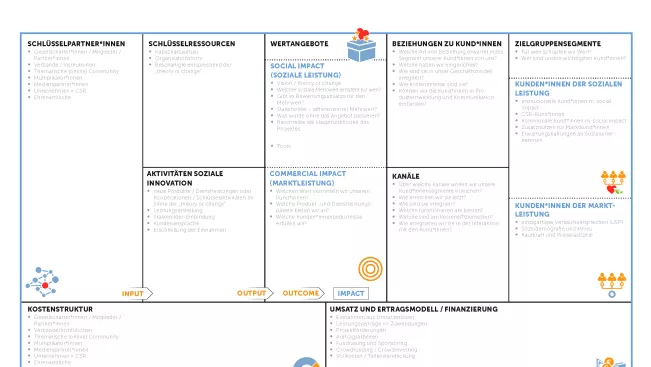
The Social Business Model Canvas includes the following areas, among others:
- Social problem: What exactly do we want to change?
- Beneficiaries: Who benefits directly from our solution?
- Impact: What is our overarching goal, both in the short and long term?
- Solution approach & offering: What exactly do we offer?
- Resources & partners: Who do we need to implement our solution?
- Financing: How do we secure our economic basis?
- Impact logic: How does everything fit together – from activity to impact?
Filling in the canvas often reveals entirely new perspectives. You may find that important target groups have been overlooked, new impact paths are opening up, or your financing model is not yet fully developed. Working on the canvas helps you develop a comprehensive understanding of your idea – alone or in a team. Not only do you refine your business model, but you also put your idea through its paces.
Would you like to review your canvas with us?
What actually is ... impact investing?
Impact investing means investing money in such a way that it has a dual effect: it should generate returns while also making a positive contribution to society and the environment. Unlike traditional investments, the focus here is not on maximizing profits, but on striking a balance between impact and profitability.
Impact meets return
At its core, impact investing combines two goals:
- Financial gain: The capital should grow.
- Social benefit: The investment must demonstrably create social or environmental improvements.
Impact is not a side effect here, but the central decision-making criterion.
Who are impact investors?
Impact investors differ from traditional investors in their attitude and criteria:
- They want not only to profit, but also to shape change, for example, through climate protection, equal opportunities, or social innovation.
- They do not ask first about the fastest exit, but about the potential impact of a project.
- They come from a variety of backgrounds:
- Foundations that want to use their capital in an impact-oriented way.
- Family offices and wealthy individuals who take on social responsibility.
- Specialized funds and networks that invest specifically in social innovations
How do you find suitable investors as a founder?
- Check for a values match: Don't look for “just any investor,” but rather for investors who share your mission.
- Use networks: Universities, start-up centers, and impact communities often offer access to relevant contacts.
- Make your impact visible: Impact investors expect you to clearly define and measure your impact—just as you would your financial plan.
Conclusion
Impact investing shows that capital can do more than just generate returns. It can be used in a targeted manner to solve social challenges. For founders, this means that with the right attitude and a clear impact strategy, they can not only raise money for their own projects, but also bring strong partners on board who are pursuing the same goals.
Brief explanation: Impact measurement for social and public welfare-oriented start-up ideas
Anyone who wants to start a social or ecological business automatically thinks about impact: What does my offering actually change - and for whom? But there is a crucial step between aspiration and reality: impact measurement. It reveals what your idea actually achieves—and helps you make informed decisions.
Why impact measurement is indispensable
Impact measurement is not a bureaucratic addition. It provides orientation and protects against well-intentioned but ineffective measures. Three reasons why it makes a difference for founders:
- Clearly define goals: Many projects start with a strong mission but vague impact goals. Impact measurement forces precision: What specifically should improve for your target group, and how would you recognize that?
- Use resources wisely: Especially in the early stages, time, money, and team capacity are limited. Impact measurement shows which activities generate change and which are more effort than benefit.
- Build trust: Whether funding institutions, impact investors, or cooperation partners: they want to understand why your solution works. Those who can demonstrate their impact in a comprehensible way score points for credibility and professionalism.
What is actually being measured?
Impact measurement considers not only the end result, but the entire chain of effects. It usually involves three levels:
- Outputs – what you do: The direct result of your activities. Example: Number of workshops held, people reached, services provided. Outputs are important, but they are not proof of impact.
- Outcomes – what changes: The central part: What changes do your target groups experience as a result of your offering? For example: more knowledge, better opportunities, new skills, more stable living situations.
- Impact – what remains in the long term: The deeper effect at the societal level. This is more difficult to measure, but important as a long-term orientation: Does your solution contribute to social equality, participation, or ecological change?
Important: Impact measurement should be pragmatic. Small projects in particular do not need complex indicator systems. It is sufficient to define a few meaningful measurement points that test your assumptions.
How does impact measurement work in practice?
The starting point is always an impact logic, i.e., a clear model that shows how your activities lead to the desired changes. The central building blocks:
- Social problem: What challenge do you want to tackle?
- Target groups: Who specifically should benefit?
- Change goals (outcomes): What should improve for these people?
- Activities: What are you doing to bring about this change?
- Measuring points: How can you tell if you are on the right track?
This model shows whether your measures are really leading to the goal or whether you need to make adjustments.
When is impact measurement worthwhile for founders?
The right time depends on the phase of your project:
- Early phase: Ideal for refining your idea, testing assumptions, and developing a clear focus. Here, measurement is primarily a thinking and learning tool.
- Funding context: Many programs expect a comprehensible impact logic. Here, impact measurement is a prerequisite for appearing professional and creating well-founded reports.
- Growth and scaling: As soon as your offering grows, impact measurement helps to ensure quality and set priorities based on data.
- Cooperation: Joint projects need common goals—impact measurement creates a shared understanding of success.
Conclusion
Impact measurement is not a complicated analytical tool, but rather a strategic support for anyone who wants to bring about social change. It provides clarity, strengthens decisions, and shows whether your idea delivers what it promises.
For social and public welfare-oriented start-up ideas, impact measurement is therefore not only helpful, but also a central component of a professional and sustainable start-up strategy.
Thought experiment
What if, imagine that ... Thought experiments help us broaden our horizons and question our own beliefs. By questioning existing and sometimes outdated processes or realities, we may come up with solutions that are needed to change our society and situation in the world.
Thought experiment: Would you make your product more expensive in order to produce it fairly—even if it meant selling less?
Sustainability sounds good. Fairness too. But as soon as it comes down to specifics, such as pricing, things can get complicated: How much idealism can your business model tolerate?
The conflict of objectives: impact vs. sales
Many founders with ideas focused on the common good are faced with a key question: How can they develop an economically viable model without compromising on social or environmental values?
A typical scenario: You develop a product that is manufactured under fair conditions, e.g., with living wages, eco-friendly materials, or in inclusive companies. The problem: production costs rise. And so does the sales price.
- What if your target group is not willing to pay this price?
- What if you sell less as a result – but with a clear conscience?
What is more important to you: reach or impact per unit?
This thought experiment forces you to reflect:
Do you want to reach as many people as possible – even if that means cutting corners in production?
Or do you want to produce consistently fairly – even if that means reaching only a smaller, more conscious target group?
There is no right or wrong here, but a clear stance is needed. Because impact requires a strategy.
Three perspectives to help you make a decision
- Define your social impact:
What is your overarching goal? Are you primarily concerned with raising awareness, changing the market, or directly supporting specific target groups? - Analyze your target group:
Who are your customers and what are they willing to pay? Are there contacts in your network or community, or cooperation partners who could support you? - Review your business model:
Does revenue have to come purely from product sales, or are there other sources of income (e.g., subsidies, membership fees, sponsorships, licensing models)?
Fair prices are not a flaw – they are an ethos.
The courage to calculate fair prices can be part of your brand identity. But it requires clear communication: Why does your product cost what it costs? What impact are your customers helping to finance? Transparency and storytelling make all the difference and create trust among those who want to not only consume but also help shape the future.
In our start-up consulting service, we work with you to analyze your business model and pricing policy – tailored to your values, your impact, and your target groups.
You have an impact idea?
SoNaR - Sozial gründen, nachhaltig wirken
Hochschule Bonn-Rhein-Sieg University of Applied Sciences, the University of Bonn and Alanus University are launching the project SoNaR - Sozial gründen, nachhaltig wirken: Impact Cluster Region Bonn-Rhein-Sieg as part of the programme "Nachhaltig wirken - Förderung gemeinwohlorientierter Unternehmen" of the Federal Ministry of Economics and Energy (BMWE), a new program to support start-ups that are oriented towards the common good .
Contact us

Karoline Noth
Project lead SoNaR, @ Start-up-Manufaktur - das Gründungszentrum der Hochschule Bonn-Rhein-Sieg
Location
Rheinbach
Room
H 306
Address
Von-Liebig-Straße 20
53359, Rheinbach
Contact hours
Mo-Do: nach Vereinbarung
Telephone
+49 2241 865 9850Location
Sankt Augustin
Room
F 413
Address
Grantham-Allee 20
Sankt Augustin
Telephone
022418659850Contact points
Kontakt zum CENTIM
Campus
Rheinbach
Room
Gebäude H, 3. Etage
Opening hours
Termine nach Vereinbarung: Bitte kontaktieren Sie das CENTIM Team
Start-up-Manufaktur - Kontakt
Campus
Sankt Augustin
Room
F413 (Campus Sankt Augustin), H306 (Campus Rheinbach)
Opening hours
nach Vereinbarung