Communications and Marketing
Parkinson’s: ion channel as promising avenue for new drugs
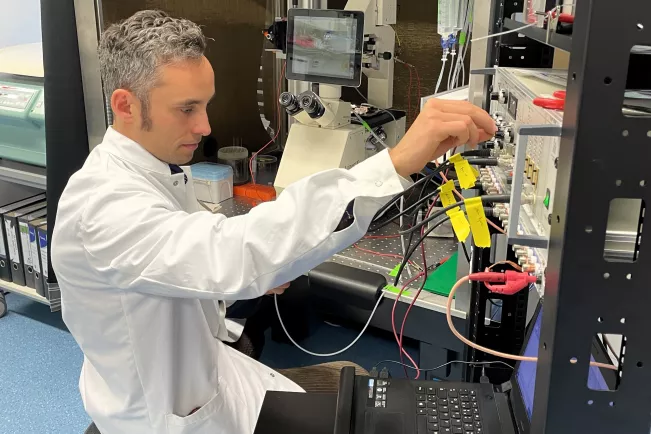
All washbasins, bathtubs and sinks have overflow protection to prevent water from spilling over the edge of the basin. Such a safety mechanism also exists in the recycling centres of human cells. This is shown by a new study by researchers from Hochschule Bonn-Rhein-Sieg, LMU Munich, TU Darmstadt and the company Nanion Technologies, which has now been published in the scientific journal PNAS (Proceedings of the National Academy of Sciences). "The ion channel TMEM175 presumably takes on the role of an overflow valve in lysosomes, which prevents excessive acidification," says Dr Oliver Rauh, research associate at H-BRS. Together with Professor Christian Grimm (LMU Munich), he is the corresponding author of the study. The researchers have used electrophysiological and bioinformatic methods to decipher the previously controversial function of this ion channel. An ion channel is a protein that is embedded in biological membranes and enables their permeability for electrically charged particles (ions).
Fine adjustment of the acidic pH value in lysosomes
Lysosomes are small, membrane-enclosed vesicles that take on the function of recycling centres in human cells - meaning that they break down macromolecules such as proteins, polysaccharides and nucleic acids into their basic building blocks. These degradation reactions inside the lysosomes are made possible by enzymes known as hydrolases. The prerequisite for this is an acidic pH value. The pH value is nothing more than a measure of the concentration of protons in an aqueous solution. The lower the pH value, the higher the proton concentration. To keep the inside of the lysosomes acidic, a transmembrane protein, the so-called V-ATPase, pumps protons into the lysosomes. However, the fine adjustment of the pH value depends on other proteins located in the lysosomal membrane. The work published in PNAS now demonstrates the crucial role of TMEM175.
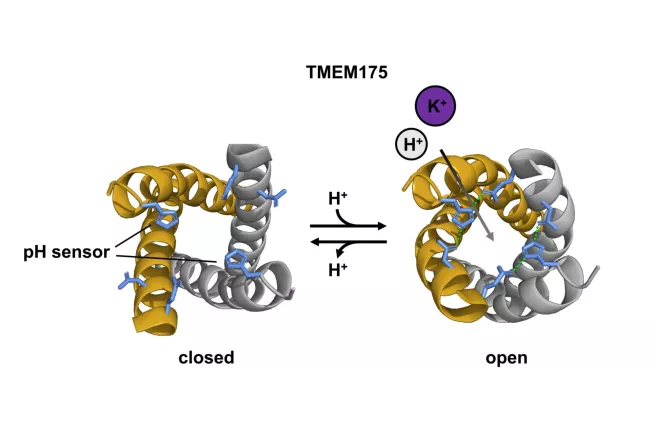
The researchers assume that the valve function of TMEM175 ensures an optimally acidic pH value in healthy cells and thus enables lysosomal degradation processes to run smoothly. In contrast, patients who carry a mutation in this ion channel suffer a loss of pH regulation. This inhibits the degradation processes of proteins in the lysosome, which in turn can lead to the death of nerve cells. Numerous research studies in recent years have shown that disorders of the lysosomal degradation function are involved in the process of ageing and the development of neurodegenerative diseases such as Parkinson's.
Proof of the crucial role of the TMEM175 ion channel
"Our study provides proof that the TMEM175 ion channel plays a crucial role in this process," says Dr Oliver Rauh. "It creates an important basis for a precise understanding of functional processes in lysosomes and at the same time provides a promising target structure with the protein TMEM175 for the development of active substances for the treatment or prevention of neurogenerative diseases such as Parkinson's." In Parkinson's disease, the death of nerve cells leads to a deficiency of the neurotransmitter dopamine. Dopamine, in turn, is needed to control conscious movements, among other things. If this neurotransmitter is missing, sufferers experience typical Parkinson's symptoms such as tremors, slowed movements or postural instability.
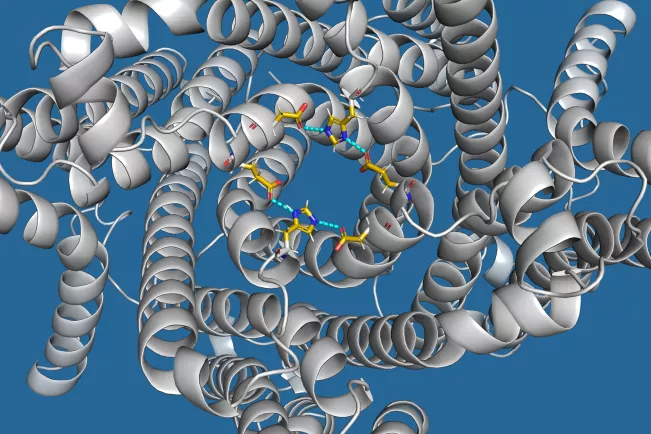
Channel protein TMEM175 conducts potassium ions and protons
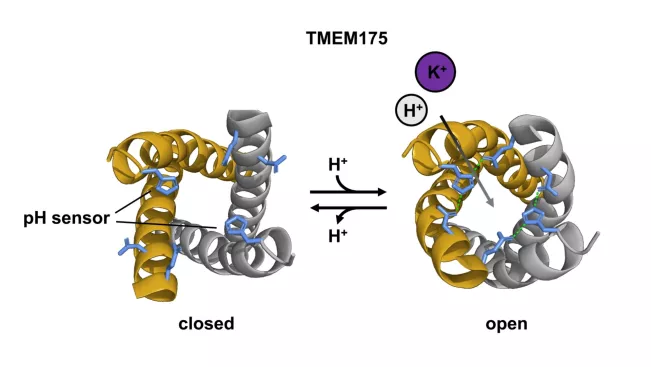
Background: The cellular localisation and function of the ion channel TMEM175 was unknown for a long time, which is reflected in its meaningless name: TMEM175 simply stands for transmembrane protein 175. In recent years, it has increasingly become the focus of research as its role in the occurrence of various neurodegenerative diseases, and Parkinson's in particular, has crystallised. In the meantime, several studies have proven beyond doubt that TMEM175 is a channel protein that conducts ions through the membrane of lysosomes. However, researchers could not agree on the question of whether this channel primarily conducts potassium ions (K+) or protons (H+) and what function the corresponding ion fluxes have in lysosomes of healthy and diseased cells.
Specific pH sensor inside the lysosome
"I have worked on many ion channels, but TMEM175 is by far the strangest of them all," says Dr Oliver Rauh, who moved from TU Darmstadt to H-BRS to work in the DFG research network "CytoTransport". "When we started the project around six years ago, it was assumed that TMEM175 was a potassium channel. Its function was completely unknown. We have now been able to show that TMEM175 not only conducts potassium ions, but also protons and is therefore directly involved in the regulation of the pH value, i.e. the proton concentration, inside lysosomes." The researchers demonstrated that the ion channel has a specific pH sensor that faces the inside of the lysosome. In this way, TMEM175 can recognise the critical acid status and adjust the proton flow through the ion channel accordingly.
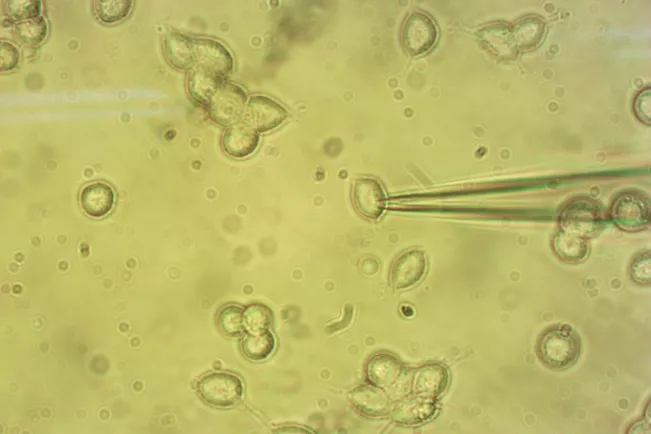
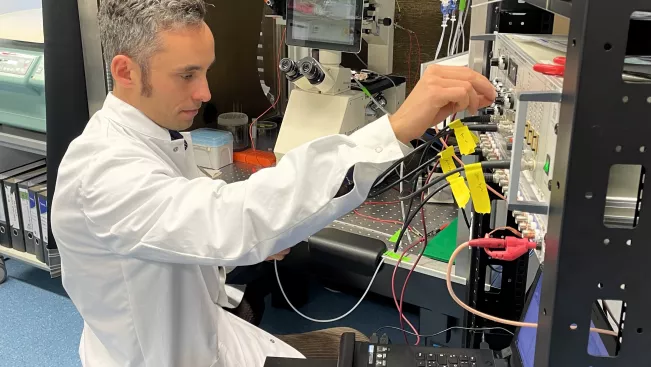
The majority of the experiments were carried out using the patch clamp technique, says Dr Oliver Rauh, explaining the measurement method for the study. "We used a thin glass capillary to gain access to the inside of a cell or lysosome. This enabled us to directly measure the ion currents that flow through the lipid membrane due to the activity of TMEM175."
Publication
Press images for download
Contact

Research fields
Location
Rheinbach
Room
E104
Address
Von-Liebig-Straße 20
53359 Rheinbach
Telephone
+4922418659778
Research fields
Location
Rheinbach
Room
E008
Address
von-Liebig-Straße 20
53359, Rheinbach
Telephone
02241 865 9541
Daniela Greulich
Deputy Head of executive department Communications and Marketing/Press and Public Relations, Press Officer
Location
Sankt Augustin
Room
E 237
Address
Grantham-Allee 20
53757, Sankt Augustin
Telephone
+49 2241 865 641