Communications and Marketing
PNAS study: Viruses as architects of complex proteins

The recent awarding of the Nobel Prize in Medicine has shown that even phenomena which appear insignificant at first glance harbour the potential for major scientific discoveries and technical developments: The award-winning researchers sought to understand how green algae are able to orient themselves towards light in a very short space of time. In the process, they discovered a class of previously unknown ion channels that are directly controlled by light, thereby laying the foundations for optogenetics, which now enables researchers worldwide to unravel the complexity of the brain. Ion channels are proteins embedded in biological membranes that allow the passage of electrically charged particles (ions).
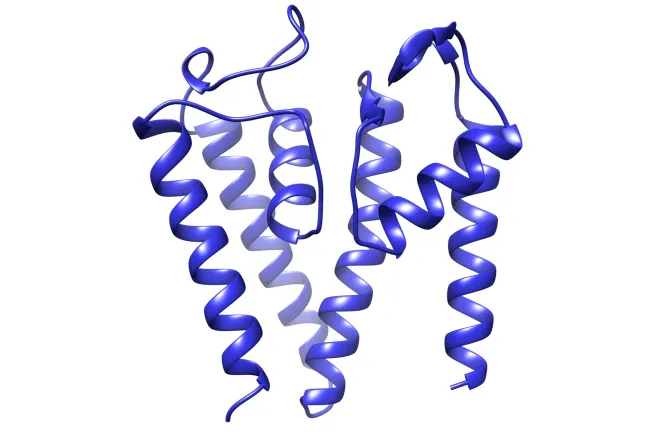
In a recently published article in PNAS, an international team – including researchers from the Department of Biology at TU Darmstadt and the Department of Natural Sciences at Hochschule Bonn-Rhein-Sieg – reports that not only green algae, but also viruses that infect these green algae, can be a source of interesting proteins. Whilst investigating the genome of a giant mimi-virus that infects marine green algae of the species Pyramimonas orientalis, the scientists discovered a gene that provides the blueprint for a so-called tandem potassium channel.
Tandem potassium channels fulfil an important function in human physiology
Tandem potassium channels are a type of ion channel. Ion channels play a vital role in a wide range of cellular and bodily functions, including, amongst others, the maintenance of salt and water balance, the perception of heat and pain, and the generation of action potentials in nerve cells. Owing to the ability of tandem potassium channels to conduct potassium ions (K+) across cell membranes, they fulfil important functions in human physiology. For example, they stabilise the electrical membrane potential and thus regulate the electrical excitability of nerve cells.
In terms of their structure, tandem potassium channels have a distinctive feature compared to all other potassium channels: whilst potassium channels usually consist of four identical subunits which together form the K+-permeable pore, in the case of tandem potassium channels, two of the four pore-forming subunits are directly linked to one another. Their name derives from this tandem-like arrangement of the subunits.
H-BRS researchers produced the protein in a test tube
Unlike all other types of potassium channels, there are no bacterial precursors for tandem potassium channels, which has raised questions in the past regarding their evolutionary origin. To investigate the function of the newly discovered tandem channel, Dr Oliver Rauh and Jonas Toews from the H-BRS produced the protein in a test tube and incorporated it into artificial lipid membranes. This enabled them to study the properties of the ion channel – more specifically, the flow of ions through the channel pore – using electrical measurements. “Our experiments demonstrate that this gene encodes a protein with the functional properties of a potassium channel,” reports Dr Oliver Rauh, who works as a researcher in the DFG research network ‘CytoTransport’ at the H-BRS.
Astonishing discovery: Gene appears to be of viral origin
The authors of the study also investigated the phylogenetic relationships between the newly discovered viral channel and previously known tandem potassium channels, and in doing so made a startling discovery: Contrary to what is generally assumed for most viral genes, the newly discovered potassium channel gene did not end up in the viral genome by being ‘stolen’ from the host’s genome. Rather, the gene appears to be of viral origin. “This finding once again underscores a new perspective, according to which the giant Mimi viruses, to which the virus in question belongs, have played a central role in the evolution of proteins in higher organisms,” emphasises Professor Gerhard Thiel from the department of Biology at TU Darmstadt.
The study’s findings also highlight that these viruses are rich sources of highly interesting proteins. For instance, other researchers have already discovered a light-controlled ion channel in the same virus, which, like the ion channels derived from green algae, is used for optogenetic applications.
Proteins of viral origin, such as the newly discovered tandem potassium channel, are also often significantly simpler in structure and therefore smaller versions of their eukaryotic counterparts. According to the authors, this minimalist structure makes viral proteins particularly well-suited as building blocks for the targeted design of proteins with entirely new properties.
Publication
www.pnas.org/doi/10.1073/pnas.2626158123
Press images available for download




Contact

Research fields
Location
Rheinbach
Room
E104
Address
Von-Liebig-Straße 20
53359 Rheinbach
Telephone
+4922418659778
Research fields
Location
Rheinbach
Room
E008
Address
von-Liebig-Straße 20
53359, Rheinbach
Telephone
02241 865 9541
Daniela Greulich
Deputy Head of executive department Communications and Marketing/Press and Public Relations, Press Officer
Location
Sankt Augustin
Room
E 237
Address
Grantham-Allee 20
53757, Sankt Augustin
Telephone
+49 2241 865 641