Research at the university
Research Database: Projects
Forschungsprojekte (264)
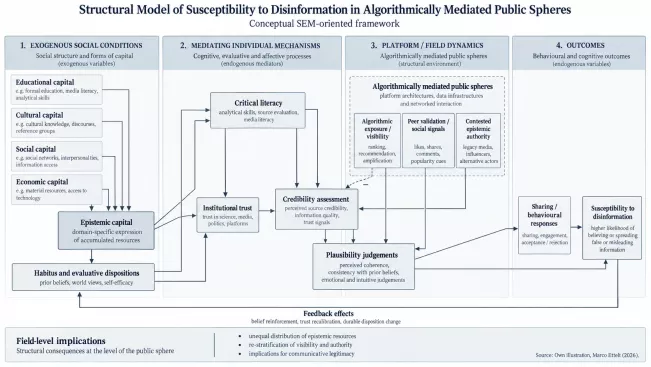
MARCO ETTELT’s PhD project investigates why young people, in particular, are subject to varying degrees of vulnerability to disinformation in digital public spheres. The focus is on how social factors such as education, cultural resources and trust in institutions interact with the visibility and evaluation mechanisms of digital platforms. The research examines how algorithmic recommendation systems influence which information becomes visible, to whom credibility is attributed, and how epistemic authority – that is, the socially recognised ability to help determine knowledge and its validity – changes. Rather than viewing susceptibility to disinformation solely as an individual cognitive deficit, this work understands it as the result of social inequalities and technologically structured information environments. Methodologically, the thesis combines quantitative and experimental approaches with qualitative methods. The aim is to develop an integrated model that explains how social position, platform structures and information evaluation interact.
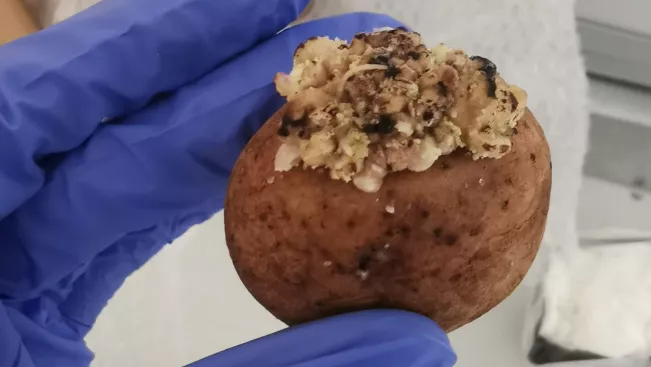
The aim of this thesis by SARAH VERMEEREN is to develop and apply a multivariate analysis method for the analysis of volatile organic compounds (VOCs) using thermodesorption-gas chromatography-mass spectrometry (TD-GC-MS). The method is intended to enable the rapid and reproducible identification of characteristic patterns and markers in complex VOC profiles. The focus is on investigating the VOCs in healthy potatoes and those infested by various pests. The aim of the analysis is to enable both differentiation between the individual pests and a clear distinction from healthy potatoes. By identifying such disease-specific VOC markers, the potential of VOC profiles as a diagnostic tool in plant pathology is to be investigated. The research combines chemical-analytical methods, multivariate data analysis and plant pathology research with the aim of establishing new approaches to the non-invasive detection of plant diseases.
In my PhD research, I, MIRIAM NAß, am investigating how cybersecurity communication can be structured within universities. The focus is on the question of which factors influence perceptions of and engagement with cybersecurity, and how appropriate communication design principles can be developed and embedded within the university context. The research combines perspectives from communication studies with organisational issues and contributes to the further development of security communication in the academic environment.
The subject of LINA MEBUS’s doctoral research is the attitudes of volunteer end-of-life carers towards information technology. ‘Attitude’ is understood here as an embodied, value-based and relational ‘way of behaving’. The analysis of this type of ‘attitude’ is carried out in the project from a media-aesthetic perspective. To this end, (media) aesthetics is understood in particular as the sensory-affective quality of situations, materials and interactions that (co-)shape such attitudes. The empirical data collected for the project is based on 17 interviews with end-of-life carers from three different hospice organisations. The data is also being prepared for a participatory format, the specific details of which are currently still in the planning phase. The overarching aim of the project is to develop a media-aesthetic contribution to the discourse on design and technology, in which central themes of end-of-life care (such as dying, death and bereavement, as well as care) are treated as key concepts within the discourse.

Hydrogen is a promising energy carrier that has recently attracted more attention. Through electrolysis, surplus renewable energy can be converted into hydrogen, stored, converted back into electricity at a later date, or used in other energy sectors. Storage systems based on this principle can be implemented on various scales: from self-sufficient energy supply for several houses to the stabilisation of energy supply networks. PhD student MICHAEL BAREEV-RUDY is working on the metamodelling of hybrid hydrogen storage systems to enable optimal sizing and control for different scenarios.
JULIANE KARNEBOGE’s doctoral thesis examines how polyolefin packaging plastics change over the course of their service life. In addition to traditional ageing parameters such as chemical influences from UV radiation, heat input and contact with media, the aim is also to understand the ageing process of recycled materials. In plastics, ageing leads to a deterioration in material properties, which are essential for safety and functionality, particularly in the packaging sector. For both virgin plastics and recycled materials, the effects arising from natural and accelerated ageing are compared, and the durability of the recycled materials is investigated. By analysing and correlating the material properties in this study, the aim is to minimise future testing efforts, thereby reducing the consumption of virgin plastic and increasing the use of recycled materials in the long term.
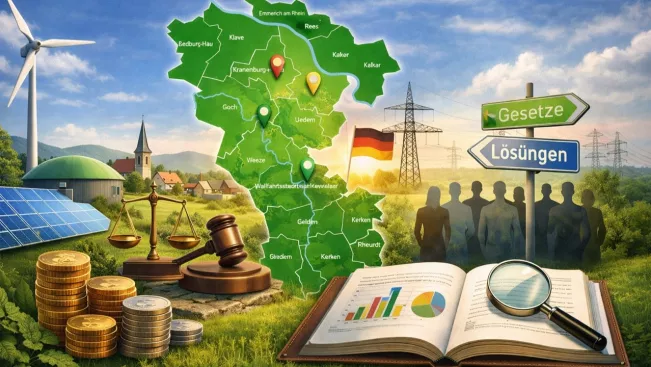
In Germany and Europe, the energy transition pursues the overarching goal of creating a climate-neutral, secure and economically viable energy supply. Germany has enshrined its goal of climate neutrality by 2045 in law. All levels of government face considerable challenges: rising investment requirements, a volatile regulatory framework and complex coordination processes between politics, business and society. Against this backdrop, the local authorities in the district of Kleve also face considerable financial, political, legal and societal challenges. Whilst ambitious climate targets require the expansion of renewable energy and the decarbonisation of local infrastructure, viable financing models and clear legal frameworks are often lacking; this is particularly true given the high level of volatility in federal and state regulation in recent years. This doctoral thesis by CHRISTIAN PETERS examines how, in the district of Kleve – which, with its 16 local authorities, has a predominantly rural structure – the energy transition can be efficiently managed despite the limited budgetary resources of the individual local authorities and the district itself, and develops practical solutions that combine economic viability with legal feasibility. The innovative contribution lies in combining an empirical cost analysis with an interdisciplinary assessment of options for local authority action.
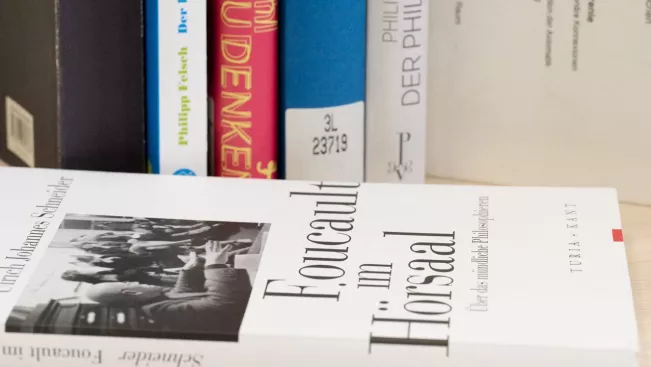
As part of her research work at the Rhine Ruhr Centre for Science Communication Research (RRC), ALEKSANDRA VUJADINOVIC examines what the humanities and social sciences understand by the term ‘theory’. To this end, she investigates concepts, ideas and materialities that revolve around this discourse and which continue to shape the corresponding research and publication culture to this day. Drawing on selected contemporary examples and discourses, she asks how theory is given form and takes shape: as a paperback in the publication series of academic and general-interest publishers? As a theory podcast? As a theory blog? As a theory meme? The aim of this work is to illustrate the role of aesthetics in the process of communicating theory.
The potential of handheld, non-destructive devices to detect ivory from Proboscidea is developing rapidly, but many research gaps remain. The elemental and structural composition of ivory provides insights into the animals' environments and living conditions, as well as their origin, all of which are highly relevant to forensic science, conservation, and provenance research. The aim of the research project is to use handheld XRF, Raman spectroscopy, and LIBS to generate new knowledge about the correlation between the origin of samples and the material composition of ivory, thereby validating the possibility of widespread use of the method by relevant authorities or museums. For this purpose, literature from the last decade was reviewed, with particular emphasis on X-ray fluorescence (XRF) and Raman spectroscopy was reviewed. Research conducted with handheld Raman spectroscopy relies on spectral bonds and focuses on species identification and age determination, whereas studies using handheld XRF analyze elemental composition and cover a broader range of topics, including distinguishing ivory from fake ivory, identifying carved ivory, detecting elemental differences in length and in cross-section, and assessing sexual dimorphism. Despite the use of XRF and Raman spectroscopy, a complementary method, LIBS, is increasingly used to link information, verify validity, and make clear statements about a sample's authenticity. NINA SCHEFFEL is conducting research on the topic.
The DINGOL research project develops a generic framework for Digital Supply Chain Twins. These twins dynamically represent real supply chains, process current operational data, and support the simulation and optimization of production, warehousing, transportation, and distribution processes. The project aims to help companies design more sustainable and resilient supply chains. The framework includes interfaces to enterprise resource planning systems, a model library, simulation and optimization modules, machine-learning methods, and a web-based cockpit for visualization and decision support.
Contact Points
Centre for Science and Technology Transfer (ZWT)
Room
F 405
Vice President Research and Transfer
Campus
Sankt Augustin