Research at the university
Research Database: Projects
Forschungsprojekte (253)
Raw meat quickly shows bacterial contamination. If the contaminated meat is consumed, it can be hazardous to health above a certain amount. That is why doctoral student DANIEL KLEIN has made contamination (e.g. bacteria) visible on complex surfaces (e.g. meat). To do this, he combined spectroscopic data from IR and Raman spectroscopy from the same measurement regions to show where contamination can be found. Combining the two methods increases the information content of the data set and at the same time reduces the error rate in contamination detection.

The aim of USHA SINGH's PhD project is to improve the match between applicants and vacancies in order to minimise poor decisions in personnel selection. To this end, influencing factors that distort objective perception and can provide clues for more efficient candidate selection are being investigated. A central component of this project is the analysis of break management, particularly with regard to the effectiveness of various interventions.

Doctoral candidate Cathleen Müller conducts expert interviews with operators of coworking spaces. She evaluates these interviews using grounded theory methodology. The aim is to identify factors that influence the material and immaterial success of rural coworking spaces in Germany. The end result will be a model that represents these factors and how they work. This model is primarily intended to support practitioners and expand research on success factors to include the field of application "rural coworking spaces".
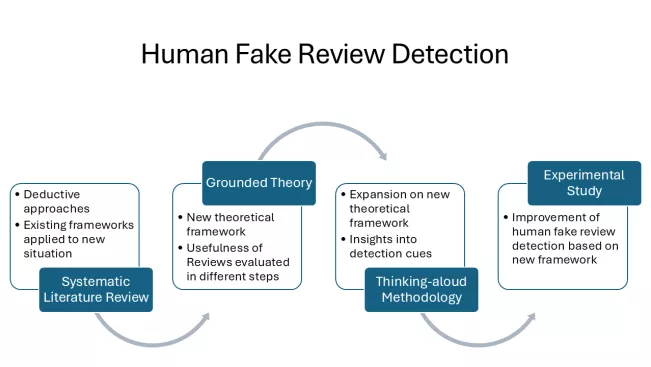
This PhD project focuses on the Research question: how do consumers detect and process fake online consumer reviews. Specifically, we develop a theory of how users process online reviews based on a combination of different methodological approaches (inductive and deductive). Using interviews, MICHELLE WALTHER developed a new theoretical framework and expanded it with a thinking-aloud study and an experimental survey. This work will provide insights into how to achieve behavioral change in consumers.
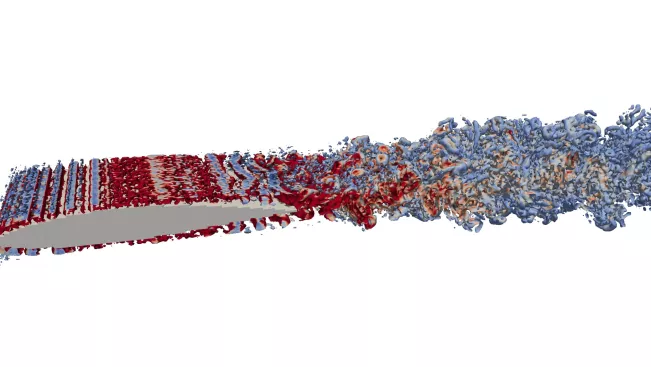
The expansion of wind turbines is essential for the energy transition. New materials and geometries are being researched to minimise noise emissions, particularly at the trailing edge of the blades. In his doctoral thesis, PHILIP SPELTEN is developing numerical optimisation methods for the development of quieter configurations using Lattice Boltzmann methods.
Women remain underrepresented in the start-up scene, and existing research is largely informed by the experiences and characteristics of men. Consequently, studies often overlook the unique challenges women face, such as taking on more care work and dealing with different pressures in their personal and professional lives. Furthermore, despite their relevance to entrepreneurial success, health-related factors have received little attention. ALINA GERKEs doctoral project investigates how female entrepreneurs can achieve long-term success while maintaining their health. It examines which personal characteristics are associated with success and how their relevance shifts across the different phases of the entrepreneurial journey. It also considers the impact of professional and private life demands on both objective outcomes and subjective perceptions of success.
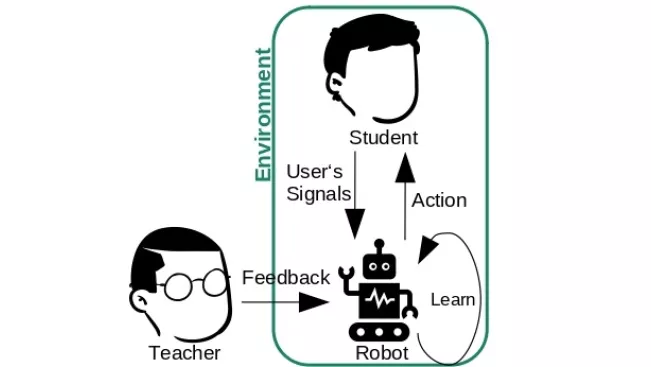
Currently, several industries and the public sector in Germany are facing the problem of the shortage of skilled human resources. Thus, it is needed to support different professions to increase the efficiency of the provided services. Various studies demonstrate that robots are able to support different user groups, e.g. elderly individuals or students, thereby easing the workload of skilled workers, e.g. caregivers or teachers. In this work, MICHAL STOLARZ chooses to support the education sector to meet the shortage of teachers. He develops an adaptive robot assisting international students in learning the German language and investigates its suitability from the student's point of view. In this approach, the robot learns how to adapt nonverbal responses for the student based on two information sources: (i) implicit student signals (e.g. engagement, emotions, tiredness), and (ii) teacher's explicit feedback (e.g. given through a tablet).
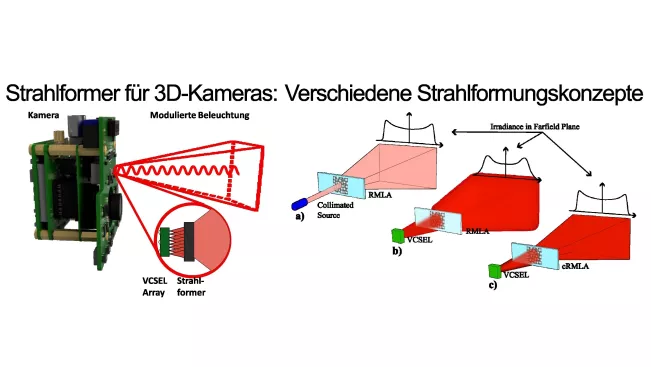
Lighting plays a crucial role in modern 3D camera systems that actively work with light. The aim of ELIAS ELLINGEN's doctoral thesis is to develop compact and efficient optics that specifically adapt the emitted light to the requirements of the respective system, for example, to illuminate certain areas more brightly or to project patterns for distance measurement. To this end, he is investigating various methods of beam shaping, such as microstructured lenses or computer-generated holograms. Simulations, prototypes and experiments are being used to identify the advantages and disadvantages of each approach. He is also investigating dynamic beam shapers that can project different patterns adapted to the measurement task. The long-term goal is to develop tailor-made lighting solutions for various applications, e.g. in robotics or industrial quality assurance, that improve the accuracy and efficiency of 3D measurement systems.
3D camera systems are considered a key technology for numerous modern applications, from product inspection to robotics and automated vehicles. Time-of-flight (ToF) cameras in particular enable fast and precise measurements in robust, compact and cost-effective systems. However, current ToF cameras have weaknesses when it comes to capturing moving or highly reflective objects. This limits their potential applications, especially in safety-critical applications. BASTIAN STAHL's doctoral project aims to significantly improve the accuracy and reliability of such systems. To this end, a dedicated measurement platform is being developed that will enable independent investigation and optimisation of the algorithms, optics and laser-based lighting components. In addition, research is being conducted into how ToF cameras can be combined with other sensor technologies, such as stereo cameras, to compensate for the respective weaknesses of individual methods. The goal is to develop a robust 3D camera system that can also be used reliably in safety-critical applications.
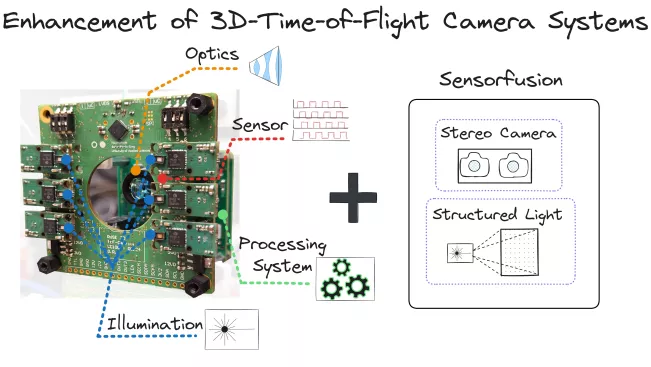
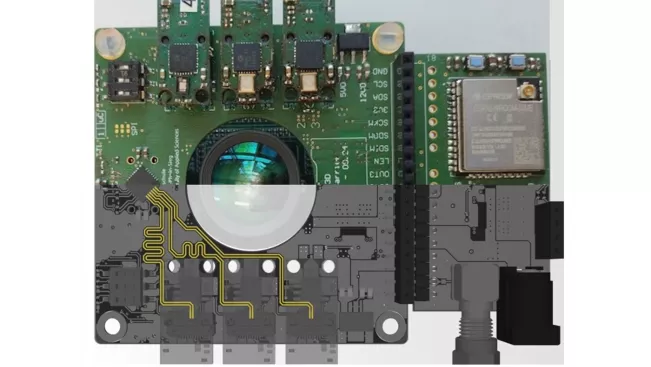
Time-of-flight (ToF) technology enables precise distance measurement by detecting the transit time of light signals. Its versatility and ability to provide depth information in real time are constantly opening up new applications. This work pursues a novel approach to improve the range and reliability of measurement. Through dynamic adaptation of the illumination using malleable beam profiles and optimised sensor control, the light distribution is to be ideally adapted to the scene. A hardware platform with multiple light sources that can be operated simultaneously or alternatively and integrated beam shapers is being designed. The aim of DANIEL RÖTHGEN's doctoral thesis is to develop a ToF camera with extended range and improved spatial and temporal resolution that enables reliable measurements even in dynamic environments. A validation sample is being built and comprehensively characterised.
Contact Points
Centre for Science and Technology Transfer (ZWT)
Room
F 405
Vice President Research and Transfer
Campus
Sankt Augustin