🎓Investigating the Interactions between the Ion Channel Epithelial Sodium Channel (ENaC) and Cytoskeleton Proteins
Promotionsprojekt im Überblick
Fachbereiche und Institute
Zeitraum
01.11.2024 to 31.10.2029


Projektbeschreibung
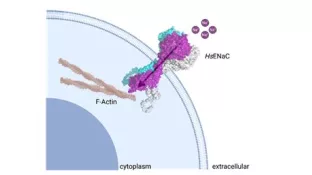
Der epitheliale Natriumkanal (ENaC), der aus α- oder δ-, β- und γ-Untereinheiten besteht, ist ein konstitutiv aktiver, natriumselektiver Ionenkanal, der für die Aufrechterhaltung der Flüssigkeits- und Elektrolythomöostase unerlässlich ist. Eine Dysregulation der ENaC-Funktion steht im Zusammenhang mit Erkrankungen wie Bluthochdruck und Mukoviszidose. Die ENaC-Aktivität wird durch intrazelluläre Proteine streng kontrolliert, die sowohl seine Ionentransportfunktion als auch seine Membranhäufigkeit regulieren. Unter diesen spielt das Aktin-Zytoskelett eine entscheidende Rolle. Studien haben gezeigt, dass kurze Aktinfilamente die Öffnungswahrscheinlichkeit von ENaC erhöhen können, was den Einfluss der Zytoskelettdynamik auf die Kanalaktivität unterstreicht. Dieses Doktorandenprojekt zielt darauf ab, die strukturelle und funktionelle Wechselwirkung zwischen ENaC und dem Aktin-Zytoskelett zu untersuchen, wobei eine Kombination aus in vitro-biochemischen Techniken und molekulardynamikbasierten Computermodellen zum Einsatz kommt.